
Loading
Part 1 of 1
DNA consists of two antiparallel polynucleotide strands forming a double helix governed by precise base pairing and enzymatic replication machinery.
 Open full-size image
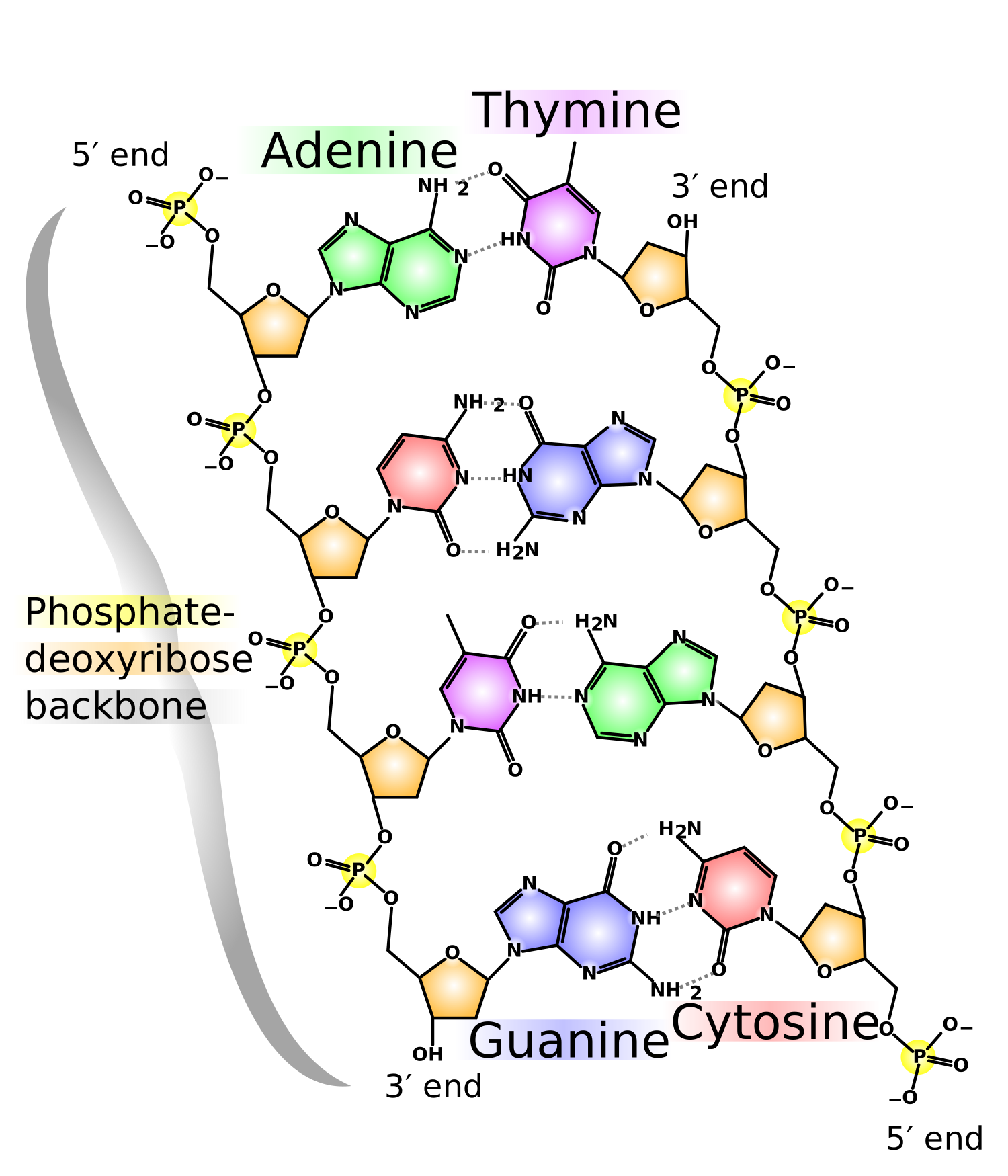
Chemical structure of DNA double helix showing antiparallel strands, sugar-phosphate backbone, and base pairs
Wikimedia Commons / Madprime / CC BY-SA 3.0
Antiparallel Double Helix
Two complementary strands running in opposite directions (5'\to 3' and 3'\to 5')
Outer hydrophilic deoxyribose-phosphate backbone with interior nitrogenous bases
Complementary Base Pairing
Adenine with Thymine (2 hydrogen bonds); Guanine with Cytosine (3 hydrogen bonds)
In RNA transcript synthesis, Uracil (U) replaces Thymine (T)
Replication Enzymes
Helicase (unwinds) · Primase (RNA primer) · DNA Pol III (5'\to 3' synthesis) · Ligase (Okazaki sealing)
Semi-conservative mechanism: each daughter helix conserves one template strand
Worked example
1.Guanine pairs with Cytosine via three hydrogen bonds in double-stranded DNA.
2.DNA replication is conservative, preserving original intact double helices.
3.RNA Polymerase synthesizes RNA using Uracil instead of Thymine.
Gain full lifetime access to all 29 lessons across 6 subjects, interactive MindMaps, step-by-step solved questions, and full timed mock exams for CEnT-S.