
Loading
Progresso di Studio
In tutti i tuoi esami
Taught in English
Questo esame si sostiene in inglese: le lezioni e le domande sono in inglese. L'interfaccia resta in italiano.
Trascina per spostarti · ⌘/Ctrl + scorri o pizzica per lo zoom · tocca un nodo per i dettagli · +/− per aprire un ramo
Formule
Rectangle and box
Use consistent units before multiplying.
Parte 1 di 1
Area and perimeter measure different quantities. A border around a rectangle changes both dimensions, so calculate outer area minus inner area. A box’s volume multiplies three lengths; capacities use whole units when partial items cannot fit. In a grid, count the admissible routes after identifying move restrictions rather than assuming diagonal movement.
 Apri immagine a grandezza naturale
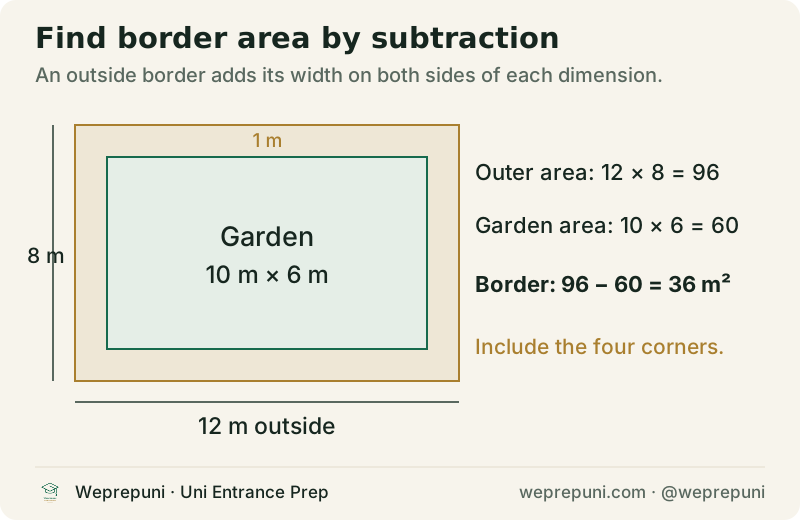
A 10 m by 6 m garden sits inside a 12 m by 8 m outer rectangle with a 1 m border. The border area is 96 − 60 = 36 square metres.
Original Weprepuni diagram
Esempio svolto
A rectangular garden is 10 m long and 6 m wide. A border 1 m wide lies outside all four sides. Find its area.
Step 1 — draw both rectangles. The border adds 1 m on the left and 1 m on the right, so the outside length is 12 m. It also adds 1 m at the top and bottom, so the outside width is 8 m.
Step 2 — subtract the inside. The outside area is 12 × 8 = 96 m². The garden area is 10 × 6 = 60 m². The border area is therefore 96 − 60 = 36 m².
Step 3 — explain the corner correction. The garden perimeter is 2(10 + 6) = 32 m. Multiplying by 1 m counts strips along the sides but misses four 1 m by 1 m corner squares. Adding those four square metres gives 36 m², matching subtraction.
In general, an external border of width w around length L and width W has area (L + 2w)(W + 2w) − LW = 2w(L + W) + 4w². This expression assumes a rectangular outside boundary; it is not the formula for a rounded border.
Accesso a vita a tutte le 4 lezioni di Problem solving, mappe concettuali interattive, quesiti risolti passo per passo e simulazioni d'esame a tempo per TARA.