
Loading
Progresso di Studio
In tutti i tuoi esami
Taught in English
Questo esame si sostiene in inglese: le lezioni e le domande sono in inglese. L'interfaccia resta in italiano.
Trascina per spostarti · ⌘/Ctrl + scorri o pizzica per lo zoom · tocca un nodo per i dettagli · +/− per aprire un ramo
Parte 1 di 1
Read the heading, unit and time period for each row and column. A larger count can accompany a lower rate. Calculate a pooled rate from pooled numerators and denominators. If a question supplies rounded data, avoid claiming precision beyond it. A weighted mean lies between the component means when weights are positive.
 Apri immagine a grandezza naturale
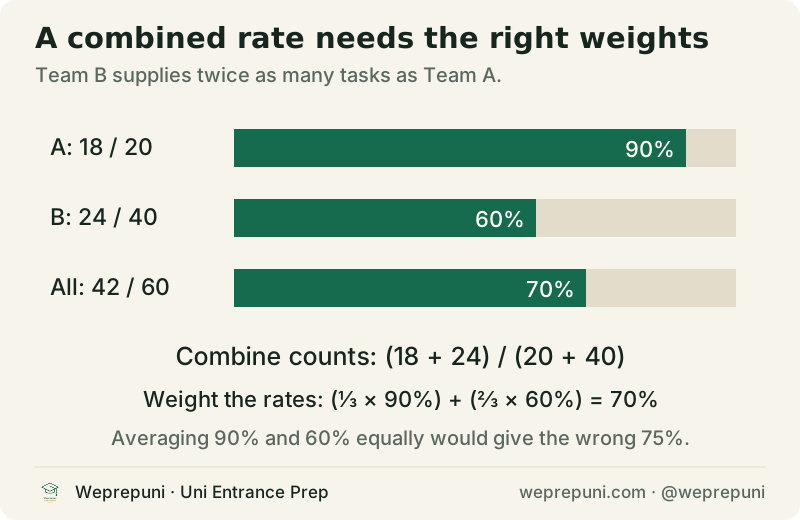
Team A completes 18 of 20 tasks, or 90%; B completes 24 of 40, or 60%. Combined completion is 42 of 60, or 70%, weighted by the task counts.
Original Weprepuni diagram
Esempio svolto
Team A completes 18 of 20 tasks and team B completes 24 of 40. Find their combined completion percentage.
Step 1 — identify the denominators. Team A has 20 tasks and B has 40. The percentages are 90% and 60%, but the teams do not have equal numbers of tasks.
Step 2 — combine counts. There are 18 + 24 = 42 completed tasks out of 20 + 40 = 60 tasks. The combined proportion is 42/60 = 7/10 = 70%.
Step 3 — check by weighting. A contributes one-third of all tasks and B two-thirds. Thus (1/3) × 90% + (2/3) × 60% = 30% + 40% = 70%. The unweighted average 75% would treat a task in A as twice as influential as a task in B.
For a separate comparison, a rate rising from 40% to 50% increases by 10 percentage points. Its relative increase is (50 − 40)/40 = 25%. State which comparison the question requests.
Accesso a vita a tutte le 4 lezioni di Problem solving, mappe concettuali interattive, quesiti risolti passo per passo e simulazioni d'esame a tempo per TARA.