
Loading
Progresso di Studio
In tutti i tuoi esami
Taught in English
Questo esame si sostiene in inglese: le lezioni e le domande sono in inglese. L'interfaccia resta in italiano.
Trascina per spostarti · ⌘/Ctrl + scorri o pizzica per lo zoom · tocca un nodo per i dettagli · +/− per aprire un ramo
Formule
Power derivative and integral
Use only where the expression and domain make these operations valid.
Parte 1 di 1
The derivative is a local slope. Differentiate rational powers and sums; simplify algebra first when it helps. A stationary point is a candidate for an extremum. Check a derivative’s sign either side or a nonzero second derivative. For a restricted domain, compare endpoints too. Monotonicity gives information about the whole graph rather than one sampled point.
 Apri immagine a grandezza naturale
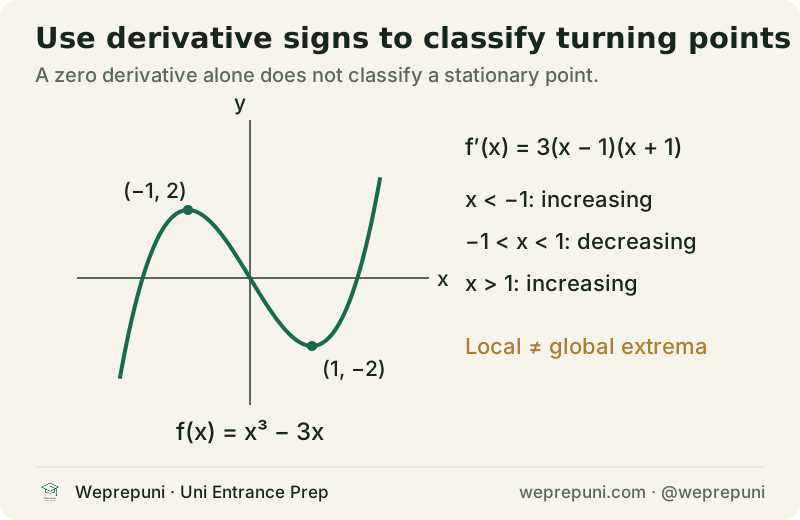
Graph of y = x³ − 3x with local maximum (−1, 2) and local minimum (1, −2); derivative signs are positive, negative, positive across −1 and 1.
Original Weprepuni diagram
Esempio svolto
Find and classify the stationary points of f(x) = x³ − 3x.
Step 1 — differentiate and solve. f′(x) = 3x² − 3 = 3(x − 1)(x + 1), so the derivative is zero at x = −1 and x = 1.
Step 2 — test signs between the roots. At x = −2, f′ = 9 > 0; at x = 0, f′ = −3 < 0; at x = 2, f′ = 9 > 0. The derivative is positive outside [−1, 1] and negative inside it. Therefore f increases, then decreases, then increases.
Step 3 — classify from the change. At −1, the sign changes from positive to negative: a local maximum. At 1, it changes from negative to positive: a local minimum. Calculate the heights: f(−1) = 2 and f(1) = −2.
Step 4 — state the scope. The stationary points are (−1, 2) and (1, −2). They are local extrema, not global bounds: the cubic tends to +∞ as x tends to +∞ and to −∞ as x tends to −∞. “Derivative equals zero” identifies a candidate, whereas the sign change classifies it.
Accesso a vita a tutte le 6 lezioni di Applications, mappe concettuali interattive, quesiti risolti passo per passo e simulazioni d'esame a tempo per TMUA.