
Loading
Progresso di Studio
In tutti i tuoi esami
Taught in English
Questo esame si sostiene in inglese: le lezioni e le domande sono in inglese. L'interfaccia resta in italiano.
Trascina per spostarti · ⌘/Ctrl + scorri o pizzica per lo zoom · tocca un nodo per i dettagli · +/− per aprire un ramo
Formule
Logarithm laws
b>0, b≠1; arguments must be positive.
Parte 1 di 1
An exponential is a multiplicative model; a logarithm identifies the exponent. For positive x and y, logb (xy)=logbx+logby. A sum inside a logarithm does not split this way. If powers share the same valid base, equality lets you compare exponents. An equation with both bˣ and b²ˣ can become a quadratic in t=bˣ, with t>0.
 Apri immagine a grandezza naturale
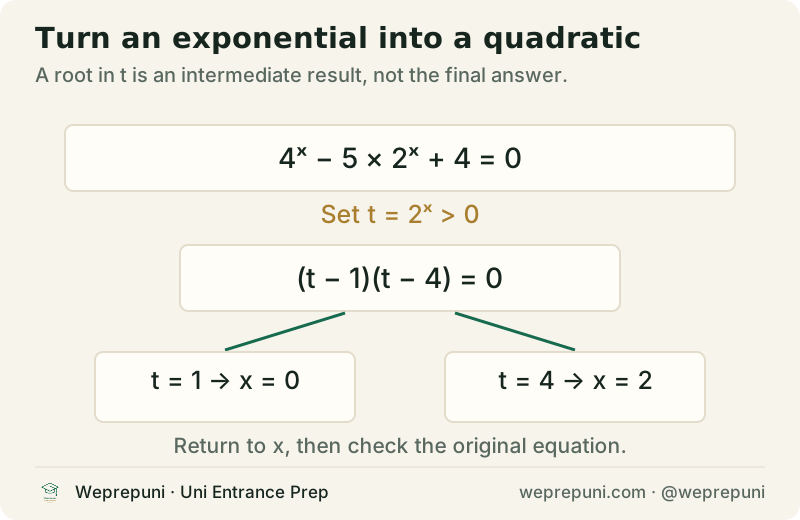
Substitution t = 2ˣ transforms the equation into (t − 1)(t − 4) = 0; t = 1 gives x = 0 and t = 4 gives x = 2.
Original Weprepuni diagram
Esempio svolto
Solve 4ˣ − 5 × 2ˣ + 4 = 0 for real x.
Step 1 — recognise a repeated quantity. Since 4ˣ = (2ˣ)², set t = 2ˣ. Every real x gives t > 0, so any nonpositive root in t would be inadmissible.
Step 2 — solve the quadratic. The equation becomes t² − 5t + 4 = 0. Factor it as (t − 1)(t − 4) = 0, giving t = 1 or t = 4. Both satisfy t > 0.
Step 3 — return to x. The equation 2ˣ = 1 gives x = 0; 2ˣ = 4 gives x = 2. Each value is unique because 2ˣ is strictly increasing.
Step 4 — check the original equation. At x = 0, 1 − 5 + 4 = 0. At x = 2, 16 − 20 + 4 = 0. The final answer is x = 0 or x = 2, not t = 1 or t = 4. Substitution simplifies an equation but does not change which variable the question asks for.
Accesso a vita a tutte le 6 lezioni di Applications, mappe concettuali interattive, quesiti risolti passo per passo e simulazioni d'esame a tempo per TMUA.