
Loading
Progresso di Studio
In tutti i tuoi esami
Taught in English
Questo esame si sostiene in inglese: le lezioni e le domande sono in inglese. L'interfaccia resta in italiano.
Trascina per spostarti · ⌘/Ctrl + scorri o pizzica per lo zoom · tocca un nodo per i dettagli · +/− per aprire un ramo
Formule
Trigonometric identity
The identity determines magnitudes; the quadrant determines signs.
Parte 1 di 1
A line’s gradient is change in y divided by change in x. Perpendicular nonvertical lines have gradients whose product is −1. A circle is a constant distance from its centre; complete squares to find centre and radius. At a tangent point, the tangent is perpendicular to the radius. A sketch helps reveal structure, but its apparent scale is not evidence.
 Apri immagine a grandezza naturale
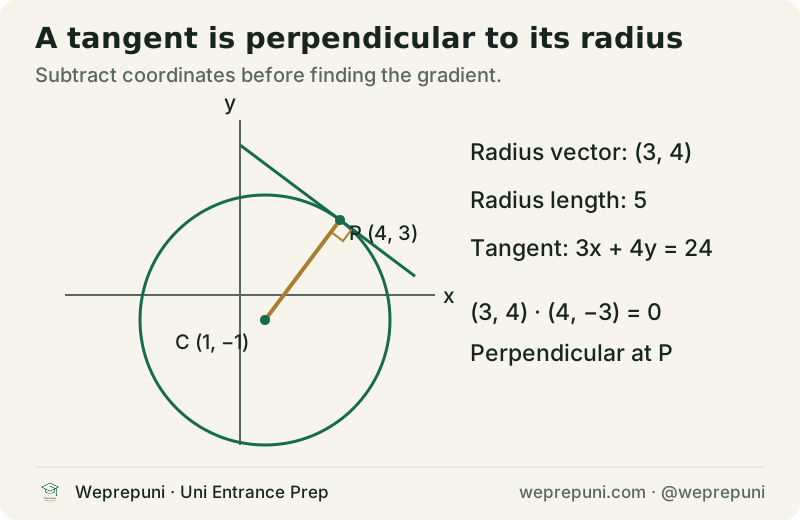
Circle centre C = (1, −1), radius CP = (3, 4), and tangent 3x + 4y = 24 at P = (4, 3); the radius and tangent meet at a right angle.
Original Weprepuni diagram
Esempio svolto
A circle with centre C = (1, −1) passes through P = (4, 3). Find its radius and the tangent at P.
Step 1 — subtract coordinates. The displacement from C to P is (4 − 1, 3 − (−1)) = (3, 4). Pythagoras gives r = √(3² + 4²) = 5, so the circle is (x − 1)² + (y + 1)² = 25.
Step 2 — use perpendicularity. The radius has gradient 4/3. The tangent's gradient is −3/4, since the product of the two nonvertical gradients is −1.
Step 3 — use the known point. Write y − 3 = (−3/4)(x − 4). Multiplying by 4 gives 4y − 12 = −3x + 12, so the tangent is 3x + 4y = 24.
Step 4 — check the result. At P, the left side is 12 + 12 = 24. A tangent direction vector is (4, −3); its dot product with the radius (3, 4) is 12 − 12 = 0. This confirms perpendicularity. For a vertical radius, the tangent is horizontal; do not use a reciprocal-gradient rule with an undefined gradient.
Accesso a vita a tutte le 6 lezioni di Applications, mappe concettuali interattive, quesiti risolti passo per passo e simulazioni d'esame a tempo per TMUA.