
Loading
Part 1 of 1
Direct current circuits route charge carriers through networks of resistors according to Ohm's law and Kirchhoff's conservation rules.
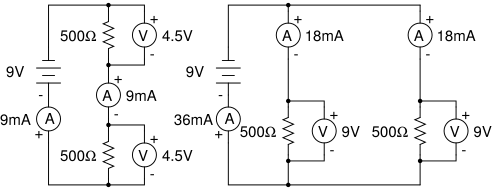 Open full-size image
Direct current electric circuits with series and parallel resistor topologies
Wikimedia Commons / inductiveload / Public Domain
Ohm's Law
V = I · R
Potential difference across an ohmic conductor is directly proportional to current
Series Circuits
Req = R₁ + R₂ + ... + Rn · Same current I through all components
Total equivalent resistance is always strictly greater than any individual resistor
Parallel Circuits
1/Req = 1/R₁ + 1/R₂ + ... + 1/Rn · Same voltage V across all branches
Total equivalent resistance is always strictly less than the smallest branch resistor
Worked example
For the exam
1.In a parallel electrical circuit, voltage across each branch is equal.
2.Connecting resistors in parallel increases the total equivalent resistance.
3.Two 10-ohm resistors connected in series give an equivalent resistance of 20 ohms.
Gain full lifetime access to all 29 lessons across 6 subjects, interactive MindMaps, step-by-step solved questions, and full timed mock exams for CEnT-S.